
How Kremenchuk breaks stereotypes about vocational education and builds economy of trust
Until recently, the building was a typical Soviet-era canteen, with worn-out windows, damaged walls, and the atmosphere of a bygone era. Today, however, students who come here from secondary schools across the city and surrounding villages are stunned by what they see, describing it as a “spaceship”.
Higher Vocational College No. 7 in Kremenchuk, in Poltava region, opened a modern DECIDE career guidance hub. This article is of how the college’s team, together with its partners, is transforming the former “vocational school” into a prestigious educational institution, where employers line up to recruit graduates even before they have received their diplomas.
The 300-square-meter space has become one of 10 such hubs already functioning in six regions of Ukraine within the framework of the Swiss-Ukrainian DECIDE Project. The total budget for the project in Kremenchuk was nearly UAH 5.3 million: of this, almost UAH 4.1 million was funded by DECIDE, UAH 1.1 million by the Poltava Regional State Administration, and UAH 110,000 from the specialist fund of the vocational college.
‘This hub is fitted with modern technology and equipment so that students can gain a practical knowledge of which career path to choose in the future. The idea behind the DECIDE career guidance hubs is to bridge the gap between education, business, and the community – so that young people can choose their career path at enterprises in their own community or region,’ says Valentyna Poltorak, DECIDE Project Manager.
The beginning and current status
The transformation began with the idea of changing not just the walls, but the very philosophy behind how blue-collar professions are thought of. Mykola Nesen, Principal of Vocational College No. 7, recalls that there used to be a canteen in one of the college buildings which had long been in need of renovation.
‘It was an old room with old windows, doors, and flooring. All of that was successfully demolished. Instead, we got more than just a renovation. The team of DECIDE developed a project, prepared a cost estimate, and skilfully managed the builders. They turned a poor-quality sweet into a gorgeous cake,’ says the principal.
The renovation took seven months. The changes even extended to the approaches to the building: the old Soviet staircase was completely rebuilt, with the plasterwork, handrails, and lighting replaced, so that the path to a future career begins with a sense of comfort and modernity. To ensure accessibility, a stairlift has been installed here for people with disabilities.
The space is now fitted out with practical workstations arranged in a “P” shape. In the centre is a mobile training area with 50 seats, complete with a large screen and a projector. There are no “do not touch” signs here – on the contrary, everything is designed to allow teenagers to experience what it is like to be an engineer, a welder, or a builder.
Robotics and comfort. At the entrance, visitors find wide window sills with soft orange cushions – a place to sit down, relax, or work on a laptop in an informal atmosphere. But the main focus is on technology. Next to this is a robotics station and a table with 3D printers.
‘We have already printed our cat – it is the welders’ mascot. Schoolchildren also try their hand at programming robots here, and they find it incredibly fascinating. Besides, we use 3D glasses for virtual assembly of electric engines – this provides an insight into the process from the inside before moving on to the actual hardware,’ explains Mykola Nesen.

‘And when we produce souvenirs using 3D printing, we always present them as prizes in a quiz about our educational institution. This really gets the children involved, as they receive gifts for correct answers, which they take home as souvenirs,’ says Kateryna Shevchenko, Head of the Centre for Career Development.
Virtual reality in welding. One of the most impressive and expensive stations is the VR simulator for welders. This high-tech simulator allows users to practise techniques using 3D glasses, without any risk or waste of materials.
‘For students, this process looks like something they would see on a spaceship. They learn how to perform manual arc or argon arc welding in a game-like format, but the simulator records every movement, teaching them precision. The magic of it all turns into professionalism,’ notes the principal.

Miniature engineering and CAD. The hub is equipped with genuine, albeit compact, lathes, milling, and grinding machines. They are fully functional and enable the production of real parts. Alongside them are modern control panels for operating the CAD machines.
‘We have five control panels where students learn to programme metalworking. This provides a foundation for future work in large factories. And for the youngest pupils, there are electrical construction kits: using solar panels, teenagers assemble circuits that power engines, gaining a practical understanding of the principles of renewable energy,’ explains Mykola Nesen.
Ecology and green technologies. In Kremenchuk, students learn not only how to work, but also how to care for the environment. The hub has a shredder for breaking down plastic and an extruder that turns old bottles into material (filament) for 3D printing.
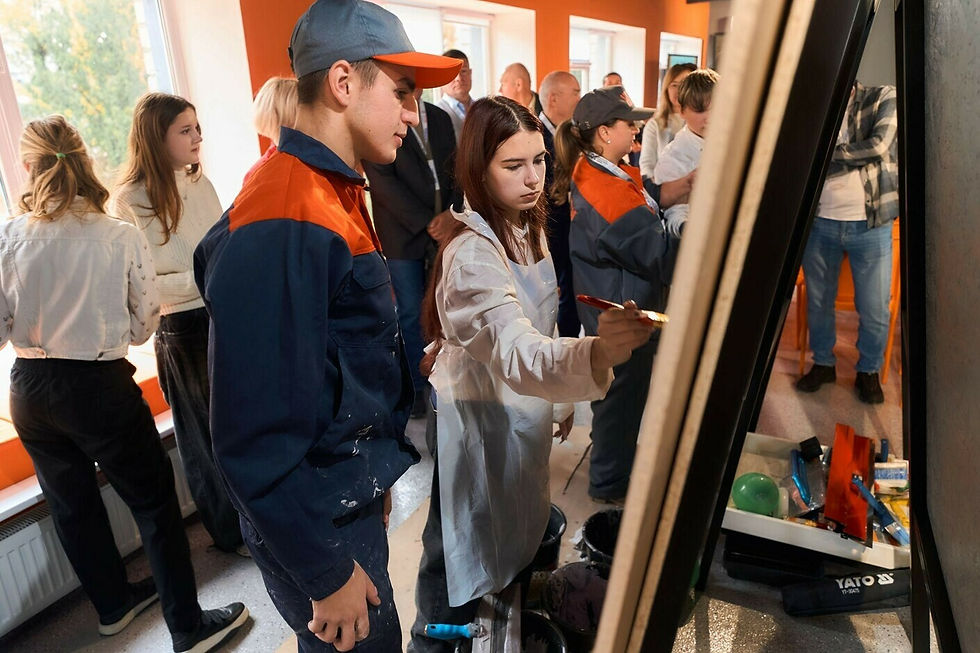
Construction aesthetics. Instead of grey walls, there are easels with decorative plaster.
‘At first, the children say, “Oh, the builders are not a good job – let’s go somewhere else.” But when they try painting patterns and see how beautiful their work is, their attitude changes instantly,’ the principal observes.
To make guests and students feel completely at home, the facility also features well-thought-out amenities. Adjacent to the main building is an additional room and a modern changing room.
‘We have fitted out the premises to be more like a typical home. For example, after classes at the construction site, where the children might get a bit dirty, they can wash their hands here and tidy themselves up. This is a practical solution that makes the space completely self-contained and comfortable,’ explains Kateryna Shevchenko.
From student to student – the best ambassador
The main distinguishing feature of careers guidance in Kremenchuk is the lack of formality. Tours for schoolchildren are often led not by teachers, but by students. Anna Kashperska, a first-year student studying to become an “Information Processing and Software Operator”, now demonstrates the opportunities offered by the hub to students in Grades 7–9 herself.
‘I show the models produced by the 3D printer, let the children work with software-controlled robots, and try out VR headsets. Schoolchildren aren’t just interested in the technology. They ask about everything: how long the course lasts, the size of the scholarship, and whether clubs and gyms are free. And most importantly – are the lecturers mean? Are there meals provided? If not a student, who else would tell them honestly? This builds trust. If someone had shown me this before I applied, I might have chosen a different career, although now I’m not so sure – everything here is fascinating,’ says Anna.

Kateryna Shevchenko adds that they use gamification during the tours: ‘Children pick a card with the name of a profession on it and try to find the relevant workplace themselves. This helps them understand what different specialists do and gives them a chance to learn about different technologies. This approach brings real results. One of the secondary schools brought a tenth-grade class, and after the visit, the girls said they wanted to leave school and enrol with us to train as electricians. Above all, we showed them the financial side of things – the real salaries in Kremenchuk for such specialists. The figures impressed both the children and their parents,’ says Kateryna Shevchenko.
Economy of trust
The college is closely integrated into the business community of the region. The local employers’ organisation KORD comprises 38 enterprises, and Vocational College No. 7 is the only educational institution amongst them.
Cooperation with business here takes the form of a partnership on equal terms. For example, the “Storozhuk” factory near Kyiv, where graduates often go to work, made the following observation: the welders are good, but they do not know how to use laser welding equipment.
‘We said: they will know how if you donate such a machine to us. And they did! The machine, worth UAH 250,000, is now used in our teaching process,’ says Mykola Nesen.
Another example is Danone, which has introduced scholarships for the four top students at the college, worth UAH 15,000 each. The companies “D Light” and “Alfateks” donate Arduino kits for automation and a laser engraver, recognising that they are investing in their own future.
The hub has become a gathering place not only for young people but for the whole community. It is home to the Veterans’ Coordination Centre and the “Good Deeds of VPU-7” charitable foundation. The college has its own military history museum, which, amongst other things, honours the memory of 80 graduates who died defending Ukraine.
Internally displaced persons undergo retraining at the college. The principal recalls a lawyer from Mariupol who trained as an electrician: ‘She now successfully manages a department at a company and says she has finally found her calling in life.’
On changing stereotypes and on new horizons
Recently, during an Open Day, Mykola Nesen met an alumnus who had graduated 18 years ago and had now brought his son here. This meeting was the best confirmation that the path taken was the right one.
‘This man came up to me and said, “Mr Nesen, I remember when my father brought me here. You were saying almost the same things back then as you are today, but about different professions. And you know, back then your eyes didn’t shine as brightly as they do now. Now I understand why – because this is a completely different educational institution. If a hub like this had existed in my youth, we would have chosen our careers quite differently and would certainly have gone on to work in our chosen fields”,’ the principal reflects.
Today, 850 full-time students study at Vocational College No. 7. The college has 35 classrooms, 9 laboratories, and 13 workshops, which, in terms of their equipment, resemble modern factories. Here, students can gain qualifications in high-demand specialisms:
skilled worker
Electrical fitter specialising in the repair and maintenance of electrical equipment;
Multi-skilled machine operator;
Numerical control (NC) machine operator;
Welder (manual, semi-automatic, and argon arc welding);
Data processing and software operator;
Accounting data clerk and computer data entry operator;
Plasterer, tiler, painter;
Carpenter and plasterboard installer.
Junior Bachelor’s degree based on vocational education programmes
Materials processing technology using machine tools and automated production lines;
Maintenance of computer-controlled machine tools and robotic systems;
Installation and maintenance of electrical machinery and equipment;
Welding operations;
Maintenance of software systems and complexes;
Construction and operation of buildings and structures.
The next step is the official reorganisation into the Kremenchuk Engineering and Technology Vocational College.
‘Instead of complaining about the darkness, why not light a candle?’ concludes Mykola Nesen. ‘We can complain about the war and the hardships, or we can build hubs, introduce new qualifications – such as a renewable energy technician – and give young people a future here in Ukraine. We are making every effort to change the perception that a vocational education institution is just some sort of technical college. Our motto is: do today what others will only dream of tomorrow. We are creating an educational institution where we would want our own children and grandchildren to study.’
These are not empty words. According to the principal, 90% of the children of the college’s staff attend the college itself. Among the college’s graduates are Mykola Nesen’s own son and daughter, and even a married couple who are both teachers.
Thanks to the support of the community and DECIDE Project, the Kremenchuk hub has become proof that education reform is not about paperwork, but about the eyes of teenagers that sparkle with excitement when they start an engine they have assembled themselves for the very first time.
The DECIDE project is implemented by NGO DOCCU and PHZH International Projects in Education with the support of the Embassy of Switzerland in Ukraine.