


Renovation of senses: How Savran transformed a former russian headquarters into an innovation hub for young people
Formerly, the building, constructed in 1854 on the territory of the Pivnichnyi Vocational College in Savran, Odesa region, housed a russian headquarters with a casemate, and later served as a command post. During the World War II, it was home to the Romanian police and a torture chamber with a gloomy basement. For many years, this building scared off passers-by: a collapsed roof, damp and cracked walls, the smell of neglect and a gruesome history. It was impossible to legally


Within DECIDE Summer Clubs 2026 “We Are at Home – in Ukraine”, a special selection process opens to support initiatives for internally displaced children from Luhansk region
Due to the security situation, communities of Luhansk region are unable to apply for the general selection process for the implementation of summer clubs. In the meantime, thousands of children and young people from Luhansk region are currently living in different regions of Ukraine and need opportunities for development, social interaction, social adaptation, and professional self-discovery. For this reason, the Swiss-Ukrainian DECIDE Project is announcing a special selectio


Romny hosted a workshop “Reform of specialised senior secondary education: Opportunities and challenges for the community”
On 2 June, a workshop “Reform of specialised senior secondary education: Opportunities and challenges for the community” was held in Romny – the final event in a series of specialised advanced training programmes for community leaders, their deputies, and heads of education departments. Representatives of the Ministry of Education and Science of Ukraine, the Sumy Regional Military Administration, the Sumy Regional Council, and experts from DECIDE, 47 communities in Sumy regio


More than 400 career coordinators and 2,300 career counsellors from communities completed training within the national pilot of the career guidance system for children and teenagers
The national piloting of a career guidance system is ongoing in Ukraine to ensure that every pupil can make a conscious choice about their future educational and career path. The pilot is implemented by the Swiss-Ukrainian DECIDE Project in partnership with the Ministry of Education and Science of Ukraine. One of the key stages of the pilot project was the training of specialists who will implement the new career guidance system in communities. More than 400 career coordinato


Almost 100,000 visitors, 302 exhibitors, and hundreds of career opportunities!
The second Career Festival at the Expocentre of Ukraine became just that, with the Swiss-Ukrainian DECIDE Project as its official partner this year. During four days, the Festival brought together schoolchildren and students, parents, educators, veterans, employers, HR specialists, and all those who are looking for new professional opportunities and seeking career growth. The Career Café, organised by DECIDE Project, was one of the most notable novelties of the second Career


Key issues on implementing reform of specialised senior secondary schools in communities of Kyiv region discussed with heads of education divisions and departments of the region
In May, heads of education departments and their deputies from communities in Kyiv region completed a special advanced training programme “Decentralised education management in communities under martial law”. The professional development programme was approved by the National Agency of Ukraine on Civil Service and is worth 2 ECTS credits (60 hours). The training lasted from 11 to 27 May and was conducted remotely, whilst an in-person workshop was held in Kyiv on 28–29 May, wh


The procurement for the provision of expert services for property transfer and regulatory design within the framework of the implementation of the Swiss-Ukrainian DECIDE Project has been continued.
The public organization "Development of Civic Competencies in Ukraine" (NGO "DOKKU") is conducting a request for quotations among suppliers for the procurement of expert services for the transfer of property and regulatory design within the framework of implementation of the Swiss-Ukrainian DECIDE Project. Content of price offers (the technical specifications, accompanying documents and instructions for submitting a request can be found at the link HERE ). If you are intere
Procurement of the services of a communication coordinator within the Swiss-Ukrainian DECIDE Project
The non-governmental organization "Development of Civic Competencies in Ukraine" (NGO "DOKKU") is conducting a request for quotations among suppliers for the procurement of services for the provision of a communication coordinator for the Swiss-Ukrainian DECIDE Project. Content of price offers (the technical specifications, accompanying documents and instructions for submitting a request can be found at the link HERE ). If you are interested in the offer and are ready to beco
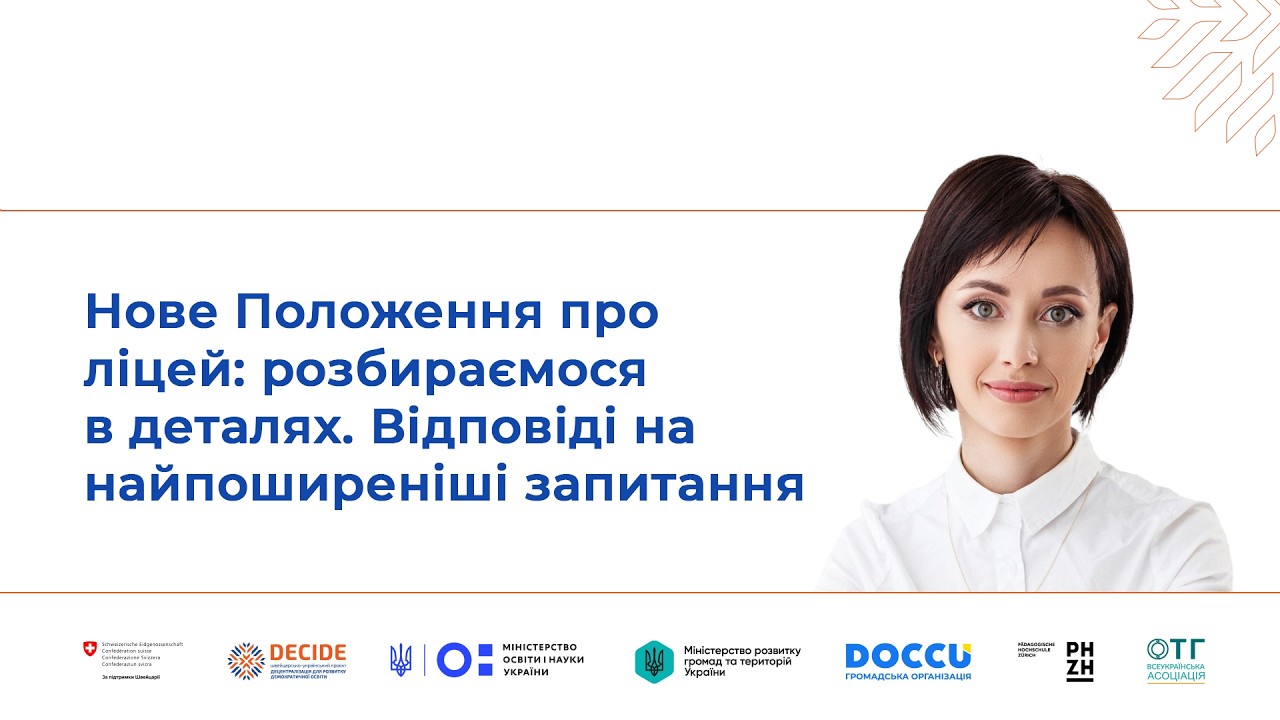
New Regulations on Lyceum: Understanding the Details. Answers to the Most Frequently Asked Questions (video)
✔️ key changes in the work of the high school, including the most pressing issues of the communities regarding the updated rules stipulated by the Lyceum Regulations. This was discussed during the webinar "New Regulations on Lyceum: Understanding the Details. Answers to the Most Frequently Asked Questions", organized by the Swiss-Ukrainian DECIDE project in partnership with the Ministry of Education and Science of Ukraine as part of the campaign "Education in New Communities

Principles of Transparency and Integrity in Community Education Management (video)
✔️ appointment of heads of educational institutions; ✔️ organization and payment of meals; ✔️ logistical support of educational institutions; ✔️ organizing transportation for students; ✔️ formation of transparent management procedures and a culture of integrity. This was discussed during the webinar "Principles of Transparency and Integrity in Community Education Management", organized by the Swiss-Ukrainian DECIDE project as part of the campaign "Education in New Communities