
From chaos to order: How Reshetylivska community is shaping its future through career guidance
‘We must believe in this ourselves – and inspire children by our example,’ says Iryna Baibuza, Deputy Principal of the Reshetylivka Lyceum and Coordinator of the Career Guidance Programme, and these words summarise the transformation of career guidance in Reshetylivska community.
The example of Reshetylivka shows how chaotic field trips and scattered initiatives can grow into a coherent, inspiring career guidance system that transforms both children and adults.
The community has managed to develop a strong partnership between schools, vocational colleges, businesses, and local authorities. Schoolchildren explore the agricultural sector, farms, the mining and processing plant, and the professions offered by local vocational colleges; they get to know high-tech machinery and the people who have turned small ventures into great success stories with their own hands; they try their hand at real looms; they fly drones; test themselves in the roles of engineers, designers, bakers and agronomists – not just in theory, but with their hands, hearts, and minds.
Everything is done in dialogue with the children, using DECIDE materials, so now they themselves suggest ideas for excursions, workshops, and other career guidance activities.
‘We will not stop there. Career guidance is important not only for our community, but for the whole country. Every person should make a conscious choice of career. If they choose something they enjoy, they can achieve success. But if they choose a job they are not fond of, they are unlikely to be any good at it. So by teaching them how to recognise their strengths and choose a path that brings them both enjoyment and a good salary, we can help our schoolchildren,’ says Oksana Diadiunova, Mayor of Reshetylivka.
The end of the era of tick-the-box events
‘In the past, in Reshetylivka, as was perhaps the case in most regions, career guidance looked like this: once a year, schools would hold a large-scale event where class teachers talked about different professions; occasional excursions were organised; and psychologists (where available) would occasionally conduct tests to identify students’ strengths. However, there was no unified system,’ begins Alla Kostohryz, Head of the Education Department at the Reshetylivka City Council.
Cooperation with the employment service was also formal: representatives from the lyceums showed videos, the pupils listened, but this had little impact on their final choice. Everything was done largely to tick boxes.
The situation changed when the Reshetylivka and Pokrovsk Lyceums became pilot schools for DECIDE: VET programme. Within the framework of the Project, career counsellors were appointed to conduct career guidance sessions based on materials from the University of Zurich; excursions to local and regional businesses have been organised for children; and schools are establishing partnerships with vocational colleges.
Moreover, the I. H. Borovenskyi Agricultural Lyceum hosts a career guidance hub that is transforming the lives of teenagers and veterans alike, as well as reshaping the entire educational landscape of the community. In this modern 210-square-meter space, pupils in Grades 7–9 may not only observe, but actually try out various professions in practice – from cooking with a 3D food printer to welding on VR simulators and driving on truck and tractor simulators.
Additionally, the hub fulfils an important social mission by helping veterans adapt to civilian life through the acquisition of new professional skills. Thanks to this approach, vocational education in Reshetylivka is becoming a conscious choice and a promising path to success, as evidenced by the increase from 18% to 30% of students enrolling in the vocational school of the community.
‘Vocational education is, primarily, about practical skills. This is a way of insuring your future, a sort of safeguard: you will always have the opportunity to work in your chosen profession, even if you cannot immediately find a job with your university degree. This is what we need to convey to school students,’ emphasises Valentyna Poltorak, DECIDE Project Manager.
Karina Yarmola, Deputy Principal of the I.L. Oliinyk Reshetylivka Lyceum and Career Counsellor, explains:
‘Our work is based on DECIDE materials developed by the University of Zurich (Switzerland), which teaches children how to get to understand themselves as a first step. This approach is proving to be very effective. Recently, for the first time in over five years, ninth-graders asked me, “Why did you become a teacher?” This means they have begun to understand that choosing a profession is not simply a matter of “where to apply”, but an important life decision.’
In general, the community agrees that there is now a greater sense of understanding, structure, and ideas.
‘For example, our schools and vocational colleges used to operate quite differently because they were under different administrative control. Now everything has changed: we have become interested in their lives, and vice versa,’ adds Alla Kostohryz.
Field trips the students took
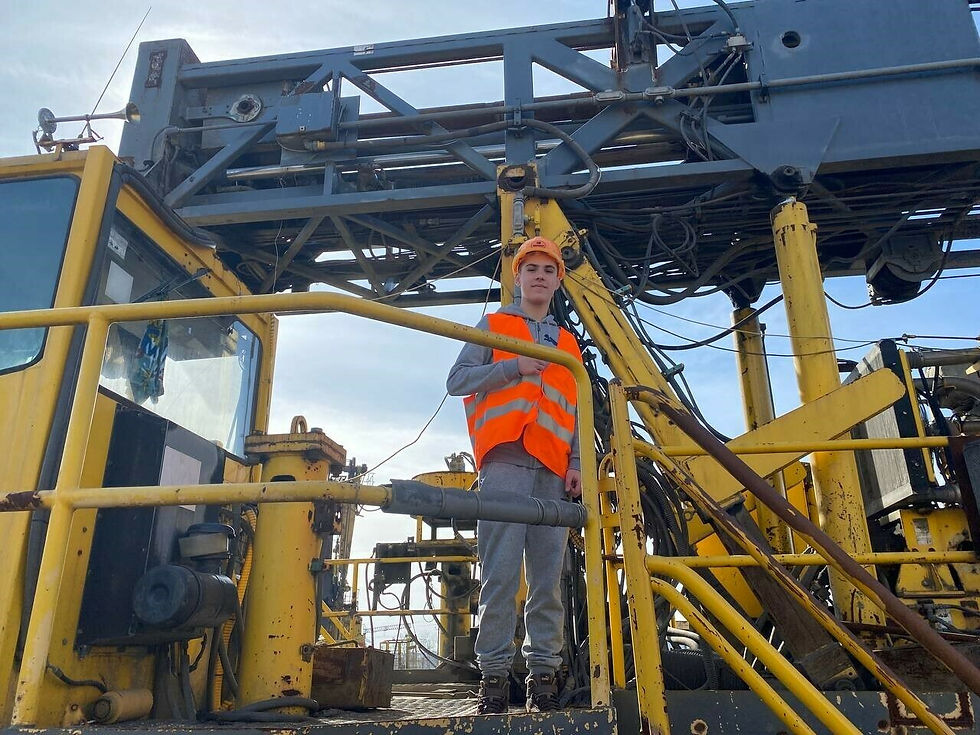
Given that Reshetylivka is a region of farmers, the career guidance programme began with visits to local limited liability companies, farms, and agricultural firms. The children learnt all the details and secrets of growing crops and caring for animals, as well as the various stages of soil preparation and sowing, and observed modern agricultural machinery in action.
Agronomists, machine operators, vets, and animal technicians – each and every one of them spoke about their work, shared interesting stories, and underlined the importance of knowledge and skills for achieving success in their chosen profession.

‘The children were most impressed by the multi-million-dollar machinery. When they look at the tractor and the company owner says, “It costs two million dollars. We have four of these,” the schoolchildren realise what a responsibility it is to operate such machinery. And then the logical question arises, “How much does a person who works with this machinery earn?”’ says Iryna Baibuza.

Iryna also explains that Reshetylivska community has long been renowned for its talented folk artists. Moreover, the Reshetylivka Art Lyceum offers courses in relevant specialisms, such as embroidery and carpet weaving. During their visit to the school, the schoolchildren learned about the practical skills required for each specialism and the personal qualities valued in this industry, as well as the unique aspects of studying at the art lyceum, the curriculum, workshops, opportunities for practical training, and future employment prospects.
The schoolchildren also visited Kernel, Ukraine’s largest producer and exporter of sunflower oil, which is also one of the leading suppliers of agri-industrial products on the international market.

The children were briefed on and partially shown the entire production chain – from growing sunflowers in the fields, harvesting, transporting the crop to the factory, and cleaning the seeds – through to processing, extracting, and bottling the oil.
Business representatives emphasised the use of modern equipment and technologies at every stage of production. This ensures high product quality, which is monitored at every stage. All of this is done to meet international standards. The product is exported to various countries around the world. Both adults and children learnt just how complex the process of delivering products to different countries is, and what the specifics of storage and transport entail.
‘We also had the opportunity to visit the Poltava Mining and Processing Plant. And this career guidance trip was a real eye-opener for everyone. We knew the Mining and Processing Plant existed in our region, but neither the teachers nor the pupils had any idea of its scale – there are around 10,000 employees working there! This is a real town within a town. Indeed, Horishni Plavni offers opportunities for vocational education, opening up employment prospects for young people,’ says Iryna Baibuza.
One of the other career guidance trips was to Klepachi. Iryna Baibuza explains that it was hard to believe that what was once an unprofitable enterprise had become a solid foundation for Klepachi’s prosperity, transforming into a large-scale agricultural cooperative. In the 1990s, the director managed not only to save the enterprise from decline but also to turn it into a successful business, providing its employees with decent working conditions and high wages.
‘An exceptionally well-kept and beautiful village, where it is pleasant to live and work. Thanks to this career guidance trip, many of the schoolchildren seriously considered for the first time the possibility of studying and subsequently finding employment in the agricultural sector. The children saw that agriculture is not just traditional work on the land, but also innovative technologies, modern management, and broad career prospects, particularly for those in blue-collar professions,’ explains Iryna Baibuza.

A youth event titled ‘I Choose Vocational Education’ was held at the I.H. Borovenskyi Reshetylivka Professional Agricultural Lyceum, bringing together school leavers from all secondary schools in Reshetylivska community.

The participants had the opportunity to learn about vocational education, its history and learning conditions, as well as the professions available specifically in Reshetylivka, such as tractor drivers, drivers, welders, pastry chefs, bakers, and bacteriological laboratory technicians.
The children attended masterclasses where they could test their skills in various activities and gain practical experience. They also had the unique opportunity to meet interesting and inspiring people who have already achieved career success. There are plans to make this a tradition for all schools in Reshetylivska community.

Apart from the main career guidance activities, the schoolchildren, who were actively involved in piloting the teaching materials for the ‘JOBS’ course, came up with a creative way to introduce culinary professions. On their initiative, and with the support of the student council, they organised a winter workshop on making gingerbread biscuits.
‘The masterclass was conducted by the chefs from our school cafeteria, and it was fascinating to see how the children’s perception of these staff members had changed. In their new role as mentors, the chefs revealed a completely different personality, and the children had the opportunity to talk to them in an informal atmosphere. The pupils took a keen interest in the techniques for making dough, the finer points of decoration, and other aspects of the art of baking. The event took place in a relaxed atmosphere and did not require significant resources. After the masterclass, we packed up the cookies, the youngest pupils made festive cards – and we sent all of this to our fellow countrymen serving on the front line,’ says Karina Yarmola, Deputy Principal of the I.L. Oliinyk Reshetylivka Lyceum and Career Counsellor.
The students also visited ornamental plant nurseries. They discovered that the name of the specialism encompasses not only the theoretical study of botany, but also a promising field of entrepreneurship.

The schoolchildren were impressed by the success story of the people who had transformed a modest home-based ornamental plant nursery into an extensive network with branches across several regions of Ukraine. Interestingly, even at high prices, high-quality ornamental plants remain in steady demand among customers.
‘It is important for children to see how small initiatives can grow into something significant. That is why learning from the real-life experiences of people who have built a successful business from scratch is, perhaps, the most valuable lesson in career guidance,’ says Iryna Baibuza.
Children from Reshetylivska community have the opportunity to visit not only local but also regional businesses and vocational education institutions. They say, ‘We want to see things that we don’t have here.’ However, whilst businesses and vocational schools in Reshetylivka are at least somewhat familiar with the community’s schools, other communities view them with suspicion.
‘Under current circumstances, large companies have legitimate reasons to restrict access to outsiders. In such cases, support from the regional authorities and the community becomes a key factor in the successful organisation of career guidance visits. Fortunately, we have that support,’ says Iryna Baibuza.
In fact, within the framework of DECIDE: VET initiative, DECIDE Project provided grants of UAH 200,000 to organise career guidance events and trips. While local funding was used to organise trips within Reshetylivska community.
‘The grant funds provided by DECIDE were a great help to us, as every family is different and children live in different circumstances. Sometimes, when I mentioned the chance to join an excursion, the pupils – not even their parents – would ask if it was free. Children understand that not all trips are affordable. So for us, this was a wonderful opportunity to involve as many children as possible, to show them the potential prospects for vocational education and future employment,’ shares Iryna Baibuza.
Career guidance brings adults together too
Alla Kostohryz notes that developing a career guidance system within the community is, among other things, a tremendous learning experience for adults:
‘We had to build contacts from scratch. There were times when we wrote to businesses, and they replied that they were unable to accept the children. But we prepared our arguments and sent another letter – and eventually, the business owners agreed. We realised how best to communicate so that people understood why we were doing this, that it was not just an excursion, but to help children decide on their future careers and look at certain professions through a completely different perspective. No one, apart from us and the businesses, will help them with this.’
Head of the Education Department at the Reshetylivka City Council also talks about organising visits to critical infrastructure facilities, which required a lot of permits.
‘When we were finalising the logistics, the representatives told us that this would be the first time they were hosting children. But when the tour was over, a communications representative rang and enthusiastically told us that the staff were extremely pleased with the tour, saying they had not expected the children to be so interested in what they do,’ says Alla Kostohryz.
The impact on the children
Karina Yarmola describes how she spoke to the children about different professions. They not only discussed possible career options but also examined real-life examples – what the pupils’ parents and their friends do for a living, and how their professional paths had developed.
‘The pupils could easily list what their parents do for a living, but they had little understanding of the nature of their daily work. We suggested the children conduct a small study and prepared some guiding questions for them to ask their relatives. When they returned with the results of these interviews, their surprise was noticeable. They discovered a great deal of new information about professions that had seemed familiar to them,’ recalls Karina Yarmola.
Interestingly, at the start of the career guidance sessions, the pupils had little understanding of their own strengths, but could clearly see their classmates’ abilities. What surprised them most was when they discovered that others’ views of their talents differed significantly from their own self-assessment.
‘During the first sessions, the children often asked, “What’s the point of all this?” Many were convinced they already knew what they wanted to be. But later on, the situation changed. Once they understood why we were doing this, they themselves wanted to return to the topics we had studied earlier. Now they were looking at the same information through completely different eyes,’ says Karina Yarmola.
Iryna Baibuza explains that the biggest surprise for the students was learning that they could spend just two or three years studying and still be successful, rather than six. Another discovery was that blue-collar professions generally offer the chance to be successful and earn a good living.
‘They ask these questions without hesitation. And this is natural. They see how hard their parents work. And they wonder whether, by choosing one profession or another, they will be able to live the life they want. I remember when the children came back from cooking workshops; they all wanted to be chefs. For some reason, they thought this profession was the most underrated. And then there were the workers in the garment factories. It turns out there are designers and fashion designers here – and that sounds cool. They were curious about how it all works, what techniques are used, and the scale of the operations. I cannot remember a single trip from which the children returned dissatisfied,’ says Iryna Baibuza.
Many children changed their minds about the prospects of moving to a big city and enrolling in universities. For some, after the excursions and career guidance sessions, a clear decision formed to study in Poltava region and stay to work in their own town. The schoolchildren themselves concluded that big cities are currently oversaturated and overburdened, and that it is sometimes much harder to find work there than to develop in a smaller town.

‘Working with parents is a big part of the process. Research shows that in 80% of cases, decisions about a teenager’s future career path are made within the family. That is precisely why parents need to play an active role in career guidance. We teach career counsellors to involve parents in this process so that they act as partners to their child, rather than imposing their own choice,’ says Valentyna Poltorak.
Such a course should be run not only for pupils but also for parents – career counsellors confirm.
‘When the children were recording videos with success stories of people in blue-collar professions from the towns where they live, everyone remembered the farmer’s daughter from our town. She said, “My dad told me from a young age that if I choose a profession I love, I won’t wake up in the morning thinking I don’t want to go to work. On the contrary – I will enjoy it.” A common theme running through these videos was that parents supported their children and gave them the opportunity to fulfil their potential in areas that they found interesting,’ says Iryna Baibuza.
Eventually, the schoolchildren became curious about the world around them and the professions of the people in their lives.
The DECIDE project is implemented by NGO DOCCU and PHZH International Projects in Education with the support of the Embassy of Switzerland in Ukraine.